


I said if I ever opened a gym (2025), I’d put a version of this quote on the front door:
We need to be upset.... Don’t come to this center to feel better; that’s not what this place is about. What I want are lives that get bigger so that they can take care of more things, more people. (Charlotte Joko Beck, American Zen Teacher)
Still no gym, but I have reworked the philosophy of GoodMenders using Beck’s insight. I’m designing peak performance training and leadership development for boys and men to help them grow stronger.
I founded GoodMenders in 2020 to build moral masculinity, principled leadership, and better culture. Those are still important pillars for me, and this evolution reflects a sharpened focus based on my personal experience and skillset.
Here’s the updated mission:
To combine principled leadership with ethical discipline and multiply that foundation with evidence-based performance training to generate high-impact athletes, teams, and professionals.
Broken down further, it looks like this:
Build a foundation of principled leadership.
Establish a practice of ethical discipline.
Multiply that base by strength—in body, mind, and spirit.
Cultivate sustainable, measurable, inspiring, difference-making performance.
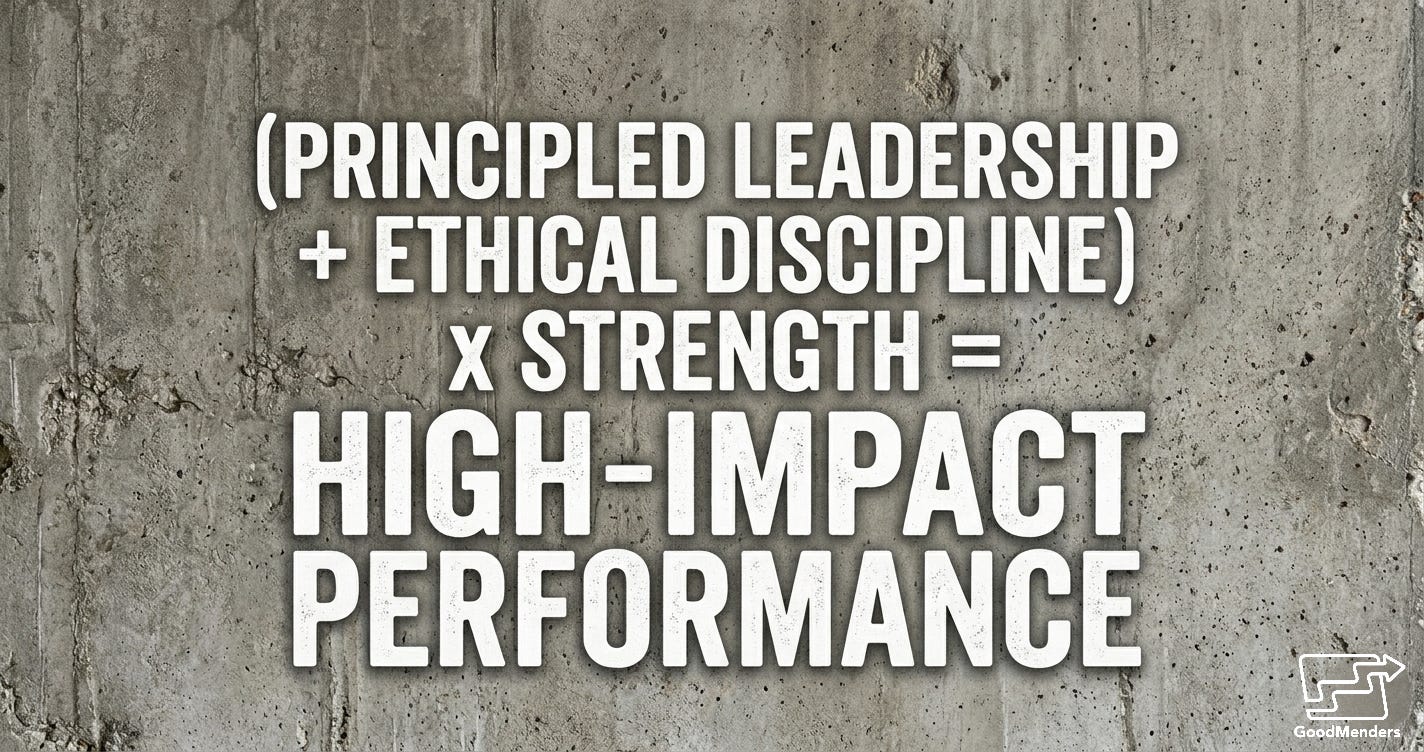
(Principled Leadership + Ethical Discipline) x Strength = High-Impact Performance
I’m excited to blend my professional experience in education and leadership with my knowledge as an athlete, coach, and NSCA Certified Strength & Conditioning Specialist® (CSCS). I’ll be integrating scientific, evidence-based best practices for sport performance with ethical discipline and leadership training to help athletes, teams, and professionals grow stronger so that they can handle more.
Going on six years, GoodMenders maintains a commitment to helping boys and men find their way. I’ll continue to advocate for their well-being and success, encouraging them to have a positive impact on their communities.
Principled Leadership
Below are a few highlighted points from an article I wrote two years ago defining principled leadership:
Principled leadership is a philosophy of leading based on sound moral judgment and an alignment with the greater good.
Leadership has become a commodity. Another badge of honor we can obtain if we read the right books, do the right training, spend enough money. Principled leadership is none of the above. It is a continuous practice.
Principled leadership is not carved in stone. Even our principles grow with us.
Principled leadership is your foundation, and I believe everyone has the capacity for it. Leadership is a skill worth practicing. It’s the vehicle for influencing the lives of others. When it is paired with quality principles...well, you can run the logic on that one.
Not everyone is a leader, but everyone can be. The world needs good leaders who model courage, confidence, composure, concentration, and compassion (the Five C’s of principled leadership, a framework for consistency under pressure). I’m not blowing smoke here. With training, practice, and experience, everyone can learn to lead.
A commitment to principled leadership is the first step to high-impact performance.
Ethical Discipline
The framework continues with ethical discipline. Here, the compounding interest of countless, proper decisions pays dividends. As Robert Collier famously said, “Success is the sum of small efforts, repeated day in and day out.” Life will have its ups and downs, achievements and setbacks, but consistent, ethical discipline will keep you on the path. Though we will wander, whether high or low, we regress to the mean.
Ethical discipline is hard work. The idea of it sounds nice. However, when we are faced with friction, we often take the path of least resistance. Ethical discipline is not that. It is:
Doing what is right, no matter the difficulty, and no matter our unwillingness to do it.
Maintaining a consistent practice that generates positive growth.
Always paying attention. Being mindful of distraction, concentrating on relevant experience, and differentiating between the two.
I believe ethical discipline is the most challenging variable in this equation to master—and the most important. It is the throughline of peak performance. Yet, all too often, we abandon the rigors of our code for the comfort of our desires. We take the extra drink, stream the next episode, check for notifications, skip the exercise. In essence, we lose our way as we submit to our insatiable hunger for a more pleasant experience.
We do not stumble upon our best and remain in a blissful state of supremacy for the rest of our lives. We should never stop practicing. We should never stop learning. The moment we think we are the best is the moment we stop growing. Ethical discipline is a commitment to growing stronger so that you can be of use.
It is with ethical discipline that we grow through pain. Charlotte Joko Beck says, “The discomfort and pain are not the cause of our problems. The cause is that we don’t know what to do about them.” By practicing moral conduct, we stop trying to escape our discomfort and start facing it. This is critical as we prepare to build strength.
Strength
We multiply the value of principled leadership and ethical discipline by developing physical, mental, and spiritual strength. Strength is good. There is nothing wrong with being strong. With strength, we are capable of carrying more weight, embracing more pain, and not collapsing under either. And, as principled leaders, we use our strength to help the team.
As an athlete and coach, I have always been enthusiastic about sport performance and fitness. For several months, I channeled that enthusiasm to become a CSCS. I loved learning how to use evidence-based practices to achieve peak performance. Through this journey, I studied the many factors that go into developing strength, and I adapted a four-step approach from the NSCA to guide future training:
Needs Analysis: identify context-specific training targets.
Program Design: design a program that will meet specific training needs for desired outcomes.
Practice and Training: execute the program to build strength and improve performance.
Testing and Evaluation: measure growth, evaluate progress, and adapt.
Like everything else we have covered, getting stronger is a practice and a progression. We go from off-season to in-season to post-season and back again. We build endurance to build strength to build power, and we rest along the way (for the right amount of time). We understand what kind of exercise to do, how to do it, when to do it, and why we do it. We learn how to stay focused on what matters, how to handle pressure, how to meet the moment. To perform well, we need to eat well, drink well, train well, and recover well.
It all adds up. The stronger you are, the higher the coefficient, the greater the growth. The more you grow, the more you can handle. And remember, if you don’t use it, you lose it, especially with age. The older you get, the more the world dumps on your shoulders, without notice. Don’t skip leg day.
Finally, a note on spiritual strength. The soul needs feeding. This is where people sometimes get tripped up and wonder, “How do I train my spirit?” Though fewer people participate in organized religion, many still consider themselves spiritual. The spirit has power over the mind and body. In Viktor E. Frankl’s Man’s Search for Meaning, he discusses the importance of spirit while reflecting on his experience in the Nazi concentration camps:
Dostoevski said once, “There is only one thing I dread: not to be worthy of my sufferings.” These words frequently came to my mind after I became acquainted with those martyrs whose behavior in camp, whose suffering and death, bore witness to the fact that the last inner freedom cannot be lost. It can be said that they were worthy of their sufferings; the way they bore their suffering was a genuine inner achievement. It is this spiritual freedom—which cannot be taken away—that makes life meaningful and purposeful. (1946)
Most of us will never live through the same horrors as Frankl, and many will never discover spiritual freedom as he did. Because he did, he was able to choose his attitude despite his nightmare of a reality. He was able to love when he had every reason to hate. While the Nazis tried to break down his body and his mind, he continued to exercise his soul. He recognized that “the salvation of man is through love and in love.”
While the body, mind, and spirit are interconnected, spiritual strength transcends the limitations of the mind and body. If spiritual practice is a gap in your training regimen, you’re leaving much of your strength on the table.
I’d suggest figuring out what feeds your soul. Then, sow those seeds.
High-Impact Performance
Through this blend of training and practice, we cultivate sustainable, measurable, inspiring, difference-making performance, what I call high-impact performance. Not only do you perform well, but that performance adds value. People want you in the room. They grow stronger with you there, more confident and competent. You are someone they can count on, and you are someone who leads with compassion.
Albert Einstein said, “Our task must be to free ourselves by widening our circle of compassion to embrace all living creatures and the whole of nature and its beauty.” When principled and disciplined leaders who are strong in body, mind, and spirit consistently and unconditionally practice compassion, they lead with purpose. Purpose has a gravitational pull. Without it, we have the feeling of being lost in space.
In popular culture, we conflate peak performance with anger, but this is not a sustainable approach. The samurai were taught to never draw their sword in anger, as they knew this led to reckless violence—wasted energy. To have a high-impact, we cannot waste our energy. Instead, through sound moral judgment, awareness, and consistency, we direct our energy to be whatever we are in the moment, and to love that moment.
Whether it be a workout or the locker room or game day, a high-impact performer sees the job that needs doing and gets it done, with joy and without complaint. High-impact performers do not wish that the circumstances were less challenging (if they do—because they are human—they observe those thoughts but do not perseverate). They do not waste their energy hoping that life will be any different than it is. They just deal with it as it is. They can handle more.
Now, to address the question a lot of people might be asking: why does GoodMenders focus on training for guys? It’s not that I think men are more equipped to be high-impact performers (women are outperforming men in significant ways, particularly in education). It’s that I am more prepared—based on my experience working with boys and men in education, leadership development, and athletics—to help male athletes have a positive impact. This is a landscape I know well, and I’d be selling you snake oil if I said I specialize in everything.
While I feel a bit like Richard V Reeves answering “Why boys and men?”, I do believe that many male athletes are struggling—between school, work, family life, mental health, and connection—even if it doesn’t seem that way on the surface. I also believe they play important roles in their communities as influencers and leaders. This is a space I’m excited to step into because the potential for good is through the roof.
So that’s what I’m cooking up at the moment. I’m a father, husband, and educator trying to have a positive impact while maintaining a beginner’s mindset—always studying to learn and grow. I believe in the cultivation of confidence, belonging, humility, and vulnerability, and I am seeking the joy of doing meaningful work. This philosophy is the latest progression in that effort. From here, it grows.
Building a stronger community starts with a single connection. If this framework resonated with you, please consider sharing it with a coach, teammate, or friend who is all about impact.
To stay updated on this work and to receive more insights on principled leadership and performance, subscribe to my Substack or visit goodmenders.com. I am grateful for your support!