


Every so often, an idea clicks into place like a puzzle coming together. It’s nice when it happens (e.g., the concept of sustaining alignment instead of juggling the unworkable “work-life balance”). This idea doesn’t have so many puzzle pieces. No complaints from me on that score.
Initially, I was thinking about a progression of skills for boys to practice in an effort to develop a positive masculine identity, and the Five C’s—courage, confidence, composure, consciousness, and compassion—clicked. I still teach the skills to boys, and, the more I have thought about them, the more I believe the Five C’s are essential for principled leadership.
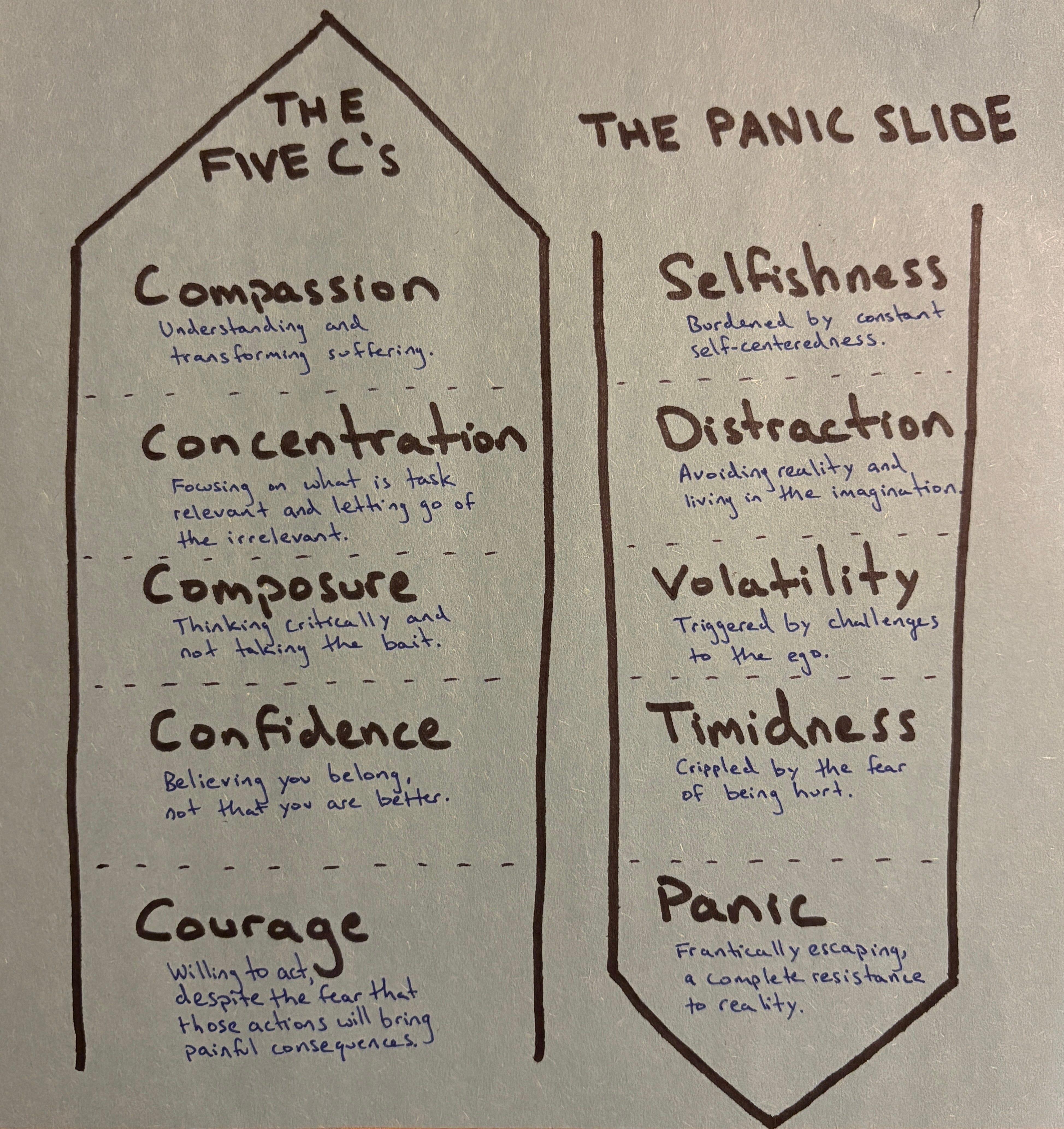
This framework has evolved since I originally introduced it in 2024. Since then, I have replaced consciousness with concentration, and I have revised the language to reflect my current thinking. I also updated the visuals, including a beautiful sketch on a piece of construction paper I stole from my kids’ craft closet because I was displeased with the AI slop. We’ll discuss the benefits of deliberate training with these five skills, as well as the downward slide—and eventual spiral—that occurs when selfishness, distraction, volatility, timidness, and panic rule the day.
Courage
We begin with courage.
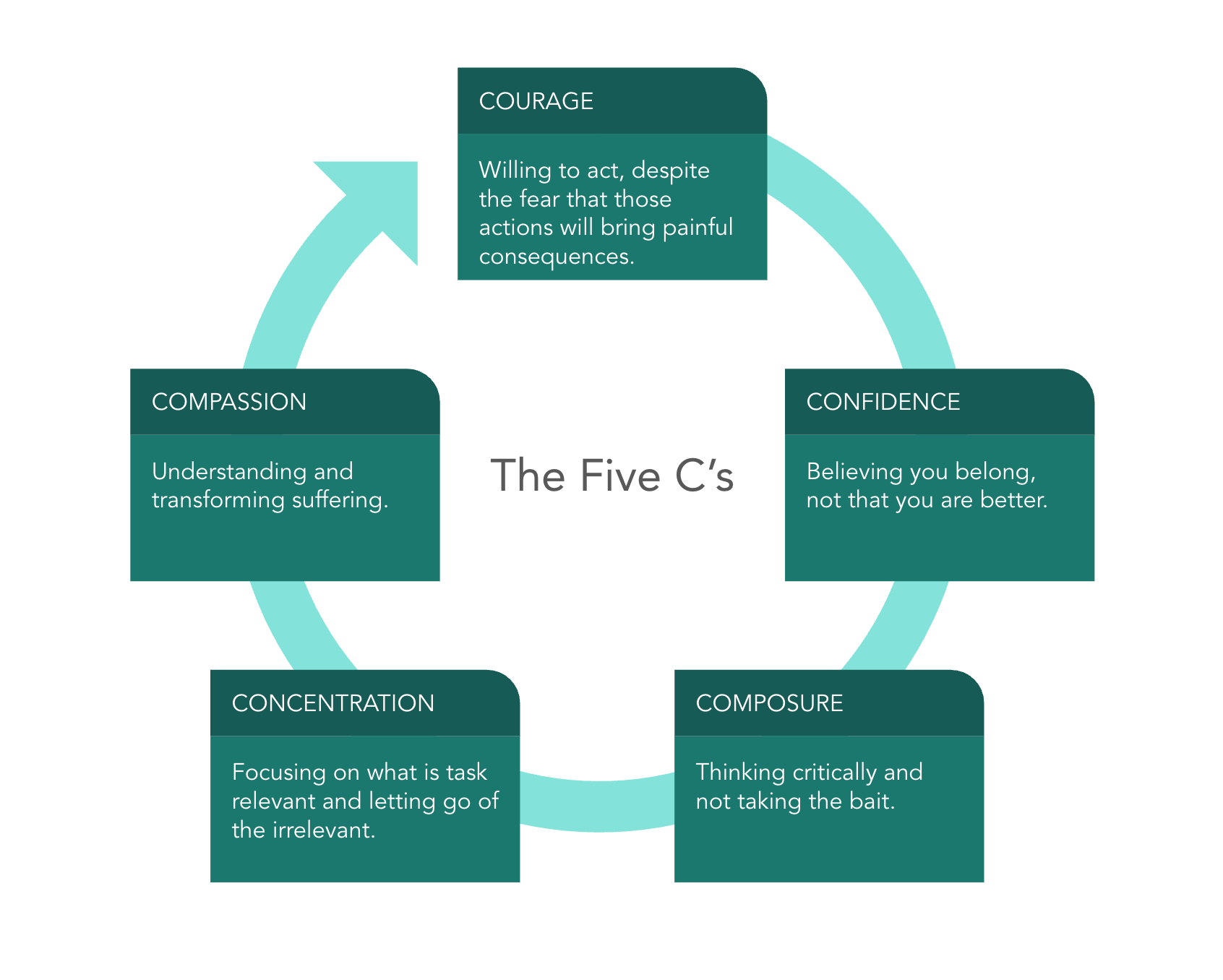
As Maya Angelou said, “Courage is the most important of all the virtues, because without courage you can’t practice any other virtue consistently. You can practice any virtue erratically, but nothing consistently without courage.” Every person has the capacity for courage: the will to act, despite the fear that those actions will bring painful consequences.
How does one practice the skill of courage? By doing scary things. Once done, and you realize, like Sanka Coffie, that you aren’t dead yet, things are less scary.
Confidence
Confidence follows courage. When people are confident, they shed self-doubt. They are honest and vulnerable. They find their voice and use their full potential to make a positive impact.
Leaders should be confident, not arrogant.
Confidence is believing you belong, that you are a part of the greater good. Arrogance is believing you are better than everyone else, that you are above and thus entitled to good fortune.
How does confidence become a skill? Reps. Countless, mindful reps. While courage deals with the unknown, confidence, built upon many successful reps, is a result of knowing.
Composure
Confidence leads to composure. Leaders who develop composure will be more effective critical thinkers and problem solvers. Without the ability to practice composure and self-discipline, selfish and non-critical thinking will follow.
The discomposed leader is doomed to an endless game of Whac-A-Mole.
There are lots of ways to practice the skill of composure (mindfulness, meditation, journaling, yoga, etc.). Whatever training you choose to invest in, it could make all the difference when the world goads you with some irresistible bait.
And here I feel obligated to include a link to Zidane’s infamous headbutt, a timeless cautionary tale of what happens when we take the bait.
Concentration
The skill of composure allows for concentration. Awareness is the first step to doing good in the world, which, I argue, is each person’s responsibility.
However, it is easy to get distracted, and it is difficult for leaders to resist the pressure to constantly innovate, produce, perform, profit, repeat. With this pressure comes a barrage of bottomless productivity rabbit holes riddled with detours (more distraction).
I have written previously about the leadership fundamentals for achieving peak performance, the psychology of success. To lead at our best, we need to focus on what is task relevant while letting go of the irrelevant.
Becoming skillful in concentration—the ability to do one thing at a time, to see things as they are, to be still—is the key to perceiving suffering, learning from it, and growing stronger. As someone who routinely fails to avoid distraction, I realize how much more mental training I ought to do (the same kind that generates composure) if I want to lead from a state of awareness and focus.
Compassion
We arrive at the tip of the arrow. The point. Once you internalize the progression—and with consistent practice—the Five C’s framework works more like a self-sustaining cycle of interrelated skills.
Albert Einstein said, “Our task must be to free ourselves by widening our circle of compassion to embrace all living creatures and the whole of nature and its beauty.” Compassion training isn’t all that complicated (if it is, consider that a red flag). Be kind as a habit. Automate giving. Put others first. Water a plant. Write a nice letter.
When leaders practice the altruistic skill of consistently and unconditionally showing compassion, without any thought of exchange, they lead with purpose. Purpose has a gravitational pull. Without it, we have the feeling of being lost in space.
Aim with compassion at your purpose, and you’ll likely hit the target.
Beware the panic slide/spiral
Now that I know the Five C’s, am I all set? Will I be a principled leader now and forever? Nope. Not really. Actually, never. What goes up must come down.
In 2021, I wrote Are you a riser or a sinker? Summary: teams do better with positive people (risers) than negative ones (sinkers), even the biggest optimists will have spells of sinking, and there is value to be gained from both risers and sinkers.
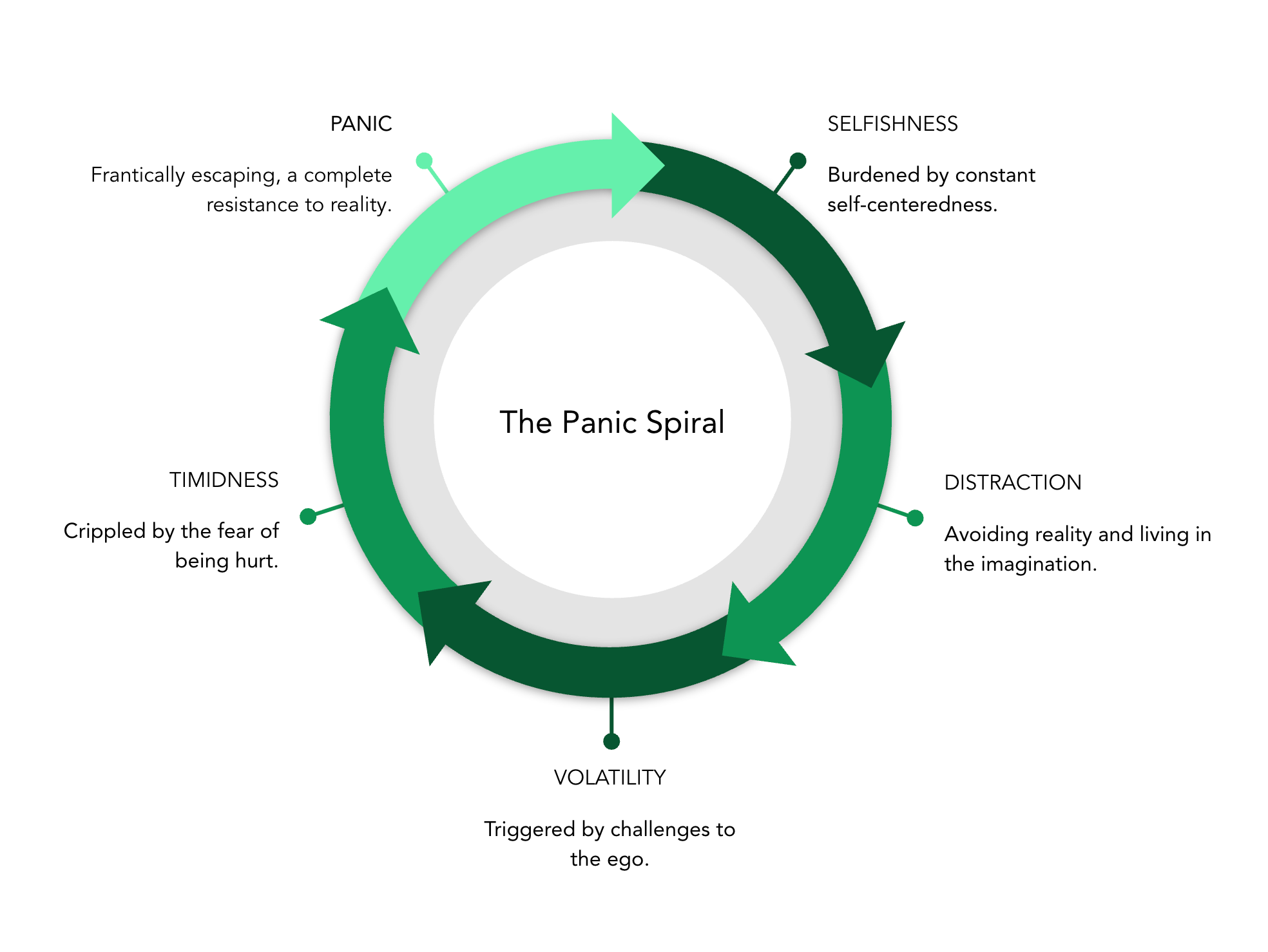
Now we add the “or” to our positive framework. Put the Five C’s into an upward arrow, flip it, and you get—the panic slide! If we observe the characteristics of sinking, we can reverse the slide before it becomes a downward spiral.
To be clear, you don’t want to ride the panic slide. Nevertheless, despite your tremendous leadership prowess, one day you will discover—to your surprise and dismay—that you are indeed sliding. Here are the features of the panic slide:
Selfishness: Burdened by constant self-centeredness.
Example: King Louis XIV of France who said, “I am the state.” His selfish rule set the stage for the French Revolution.
Distraction: Avoiding reality and living in the imagination.
Example: Nicholas II of Russia ignored the suffering of the Russian people and instead focused on his personal affairs, leading to the collapse of the Romanov dynasty and the rise of the Russian Revolution.
Volatility: Triggered by challenges to the ego.
Example: Emperor Commodus, the son of Marcus Aurelius, portrayed by Joaquin Phoenix in Gladiator. He was an erratic and ego-driven leader who left Rome in chaos.
Timidness: Crippled by the fear of being hurt.
Example: Prime Minister Neville Chamberlain was known for his appeasement of Hitler. His fear of painful consequences contributed to one of the greatest catastrophes in history.
Panic: Frantically escaping, a complete resistance to reality.
Example: Adolf Hitler epitomized this stage in the final weeks of WWII when he went ballistic in his bunker and ultimately killed himself, unable to face reality closing in on him.
Do not fear. If you’ve trained well, you can stop the slide before you come crashing down on the panic button.
Leaders who practice the Five C’s will spend more time rising than sinking. Because they concentrate, they will observe their own thinking and behavior. They will identify selfishness, distraction, volatility, timidness, and panic, understanding the roots of their self-induced spiraling.
They will know the more skillful alternative, and they will not get stuck in a downward spiral.
Final notes on training
First, there are a few important questions about training to consider:
What do you prioritize when training your team (especially during onboarding)? What do people learn first? If these skills/topics aren’t the most essential things for people to know with regards to your team’s purpose and culture, you have more questions to ask.
What does your team think about previous training you have done? How do you know? And how does that inform the decisions you make about future training?
When does your team do “soft skills” training (like the Five C’s)? What proactive culture training do you do? What signals do you look for that might indicate a need for reactive training? What percentage of your training is proactive vs. reactive? I’d strive for roughly 80% proactive and 20% reactive.
And the final note. There are very few trainings that have a lasting impact. Sometimes, it’s because the training isn’t so great. Most of the time, regardless of quality, no matter how high or low we feel post training, somewhere down the road of our busy lives, whether it be a subtle drift or full blown panic slide, we return to baseline.
The trick to effective training is this: it is repeated over time, like all good practice, building upon shared values, reminding us of that light above the clouds, the same light within each of us that supplies the energy to push forward with this exciting human project.
At my current school, we have a tradition called the sunset climb. It’s my personal favorite (and there are definitely a few C’s involved). Our graduating students hike the local mountain at sunset and, one at a time, express their gratitude for their peers and mentors. It’s an emotional moment where kids and teachers feel the weight of close friends parting ways at the end of a hard-fought journey.
This tradition reminds me why I teach, and I know that if there were more “sunset climbs” sprinkled throughout the year, I’d feel even better about my chosen profession. When you think about training, instead of going through the motions, think about creating these sunset moments.
Remember the tip of the arrow: compassion. Concentrate on the point.
Question for the club
What helpful tools, graphics, mnemonics, etc. have been useful leadership guides for you?