



Is Claude Mythos “Terrifying”? | AI Reality Check
I’m a big fan of Cal Newport’s work, including his podcast. After Anthropic announced, to the world’s horror, that its new AI model Claude Mythos was too dangerous to release to the public, Newport researched the issue and put together this 25-minute reality check (just over a week later). It’s fantastic. He reminds us to dig deeper, to practice healthy skepticism, to discover the truth through critical thinking. How many of us took the bait and formed our conclusions based on headlines alone? As someone who is interested in AI but has a hard time with the technical jargon, I know I did. I too went up to someone and asked, “Did you hear?!”
While there are lots of reasons to be concerned about AI, that does not absolve us from gathering and analyzing information to understand the issues we face as a society. This is one of my major concerns with AI and education. I worry that students won’t learn how to think critically and conduct research because AI can think for them. I asked Gemini, “Can you find expert analysis that gives me a real picture of whether or not I should be concerned about Anthropic’s Mythos?” This is better than nothing, but I didn’t get this podcast pushed to me.
This made me stop because it convinced me that we need to be mindful of how we curate our stream of information in the age of the algorithm. If we take the easy path to knowledge, we are destined for shallow thinking at best and mindless regurgitation at worst.
Men’s Health Isn’t Just Personal—It’s Structural
I’d rate my interest in the well-being of boys and men as above average, so I was excited to find a new voice in the work of Dominick Shattuck, PhD. This made me stop because I think his argument is a really important one that is easily missed: paradigm shifts require system-level thinking.
This makes me think of a diagram from Making Learning Whole by David Perkins. It illustrates three responses to “trouble spots” of teaching.
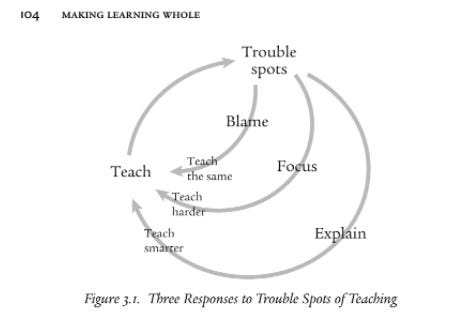
The more I look at it, the illustration isn’t great. It seems like you will end up at “trouble spots” no matter what you do, but I digress. If a student fails a test, and our instinct is to blame the student—quick and easy and ineffective—then we teach the same and likely get a similar outcome. On the other hand, if a student fails a test and we try to find an explanation for that failure, perhaps a breakdown in the system (learning, practicing, studying, test-taking, review), we are less likely to end up experiencing the same trouble spots.
If you have no interest in learning more about how social systems are contributing to the “masculinity crisis” people are talking about, that’s fine. It’s not why I included this piece. Maybe Paul Gorski’s “Avoiding Racial Equity Detours” or Michelle Alexander’s The New Jim Crow or Douglas Murray’s The War on the West speaks to you. Regardless of the system du jour, my point is the same. If we don’t like the outcomes—and if we want different ones—we can’t just blame the individual.
Build Mental Toughness & Perform Under Pressure
For those of you who are interested in fitness and human performance, I highly recommend Dr. Andy Galpin’s podcast Perform. His episode with Dr. Lenny Wiersma might be my favorite so far. They discuss sports psychology and performing in high-stakes situations.
Here are two highlights that really made me stop and think:
Self-talk, especially done in the second or third person—weird, I know—is an accessible and effective way to coach yourself. When you are looking for guidance, imagine someone you really admire, someone who has given you valuable feedback in the past, and think of what that person would say to you. This voice sounds much different than “I,” and it is a lot more helpful.
Emotional control is an impossible goal, while emotional regulation (the ability to respond to emotional situations effectively) and emotional co-regulation (the ability to regulate someone else’s emotions) are underrated skills for both player and coach. We have all seen an expert implode due to emotional dysregulation, and we have all been saved by a composed soul who has lowered our temperature. These are invaluable human assets that I don’t see AI replacing any time soon.
Whether you are interested in athletic performance or professional competency, this podcast offers powerful and practical tools.
Thank you for reading! Please feel free to share this work if you think a friend would enjoy it. To receive more insights on principled leadership, performance, and the well-being of boys and men, subscribe to my Substack or visit nicholasnowak.com.
Cheers,
Nick